Mediterranean diet science: what the big trials show and where proof is thin
Randomised trials link the Mediterranean diet to roughly 30% fewer heart attacks, strokes and cardiovascular deaths in high-risk people. Evidence on longevity and dementia is promising but mostly observational, and some headline effects shrink once lifestyle is accounted for.
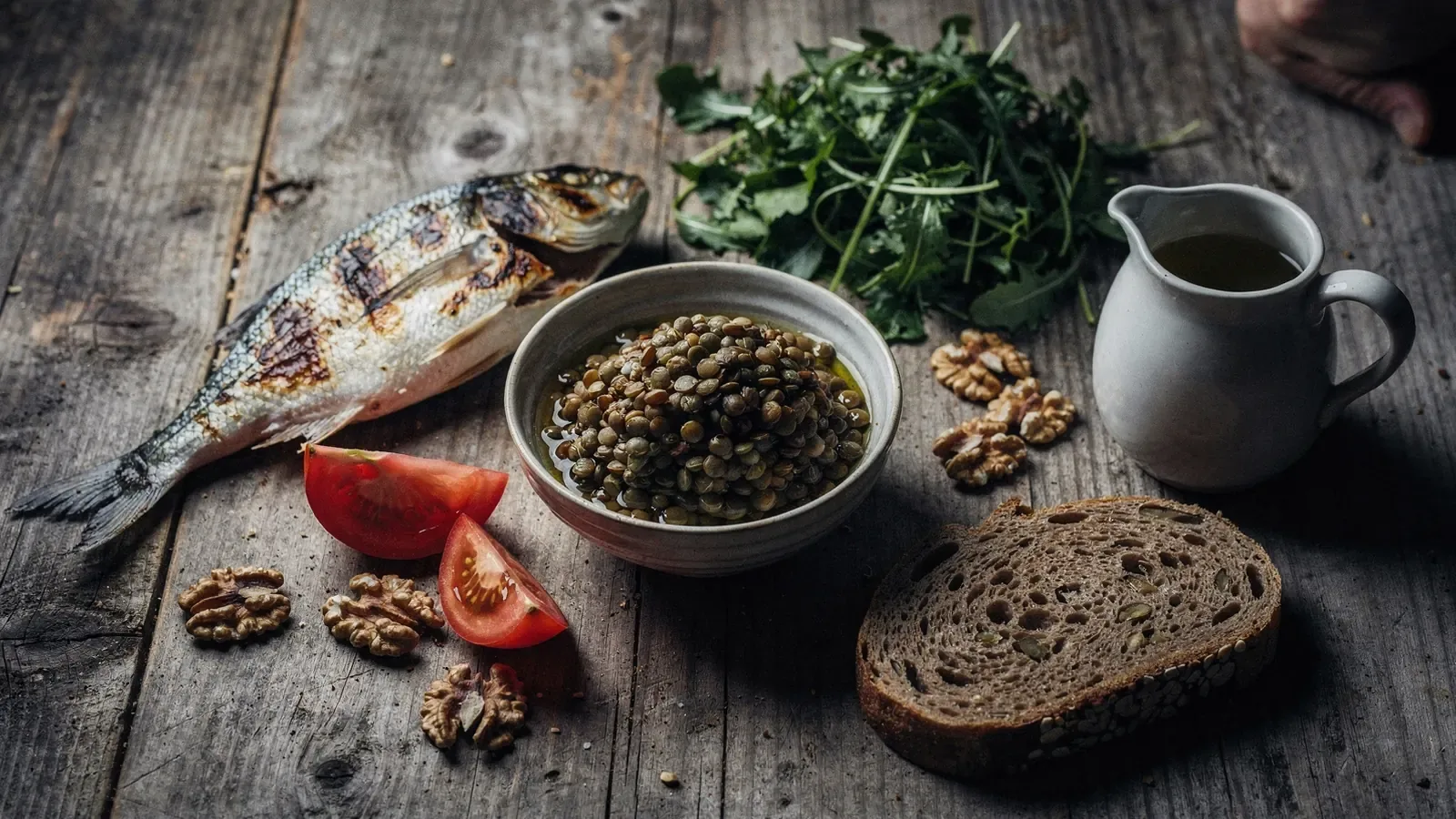
The Mediterranean diet is one of the best-tested eating patterns in nutrition science. Randomised trials have shown it reduces major cardiovascular events by roughly a quarter to a third in people at high risk or with heart disease. Claims that it helps people live longer or protects against dementia rest mainly on observational studies, which are suggestive but cannot prove cause and effect.
What counts as a Mediterranean diet?
It is a pattern, not a single food. Harvard's Nutrition Source describes a primarily plant-based diet of vegetables, fruit, whole grains, beans and other legumes, nuts, herbs and spices, with olive oil as the main added fat, fish at least twice a week, smaller portions of poultry, eggs and dairy such as yogurt and cheese, and red meat only a few times a month. That makes it hard to credit any one ingredient: the PREDIMED trial tested the whole diet supplemented with olive oil or nuts, not olive oil on its own.
Does the Mediterranean diet prevent heart disease?
The strongest evidence says it lowers cardiovascular events in high-risk people. The Spanish PREDIMED trial enrolled 7,447 people aged 55 to 80 at high cardiovascular risk but without heart disease, and assigned them to a Mediterranean diet with extra virgin olive oil, one with mixed nuts, or a control diet advising reduced fat. Both Mediterranean groups had about 30% fewer major cardiovascular events.
The trial has a complicated history. The New England Journal of Medicine retracted the original 2013 paper on 13 June 2018 because of errors in randomisation at some sites, and published a corrected analysis the same day that excluded 1,588 participants whose assignments had departed from protocol. The results were largely unchanged, the Harvard T.H. Chan School of Public Health noted.
A second Spanish trial tested people who already had coronary heart disease. CORDIOPREV, published in The Lancet in May 2022, randomised 1,002 patients in Córdoba to a Mediterranean or a low-fat diet for seven years. Major cardiovascular events occurred in 87 people on the Mediterranean diet and 111 on the low-fat diet. The benefit was clear in men but not detected in women, and the trial took place at a single hospital.
| Trial | Who took part | Main result |
|---|---|---|
| PREDIMED (NEJM, republished 2018) | 7,447 adults at high cardiovascular risk | About 30% fewer major cardiovascular events |
| CORDIOPREV (Lancet, 2022) | 1,002 patients with coronary heart disease | 87 vs 111 major events compared with low-fat diet |
| PREDIMED-Plus (Annals of Internal Medicine, 2025) | 4,746 adults with overweight or obesity and metabolic syndrome | 31% lower risk of type 2 diabetes with calorie reduction and exercise |
Can it prevent type 2 diabetes?
A calorie-reduced version combined with exercise appears to. The PREDIMED-Plus trial followed 4,746 adults aged 55 to 75 with overweight or obesity and metabolic syndrome for six years. Those assigned to a Mediterranean diet with about 600 fewer calories a day, physical activity and professional support had a 31% lower risk of type 2 diabetes than those on an unrestricted Mediterranean diet, ScienceDaily reported from the University of Navarra in October 2025.
Because the comparison group also ate a Mediterranean diet, the trial shows the value of adding calorie control and exercise, rather than of the diet alone.
Does it help people live longer?
Observational studies suggest so, but the size of the effect is uncertain. A study of 25,315 initially healthy US women in the Women's Health Study, published in JAMA Network Open on 31 May 2024, followed participants for an average of 24.7 years. Women with the highest diet scores had a 23% lower risk of death from any cause than those with the lowest.
That figure fell to about 11% once the researchers also adjusted for lifestyle factors. The women were mostly well-educated, white health professionals, and their diet was measured only once. Such caveats explain why scientists treat these findings as supporting, rather than proving, a longevity benefit.
Does it protect the brain?
The evidence is promising but not conclusive. A study in Nature Medicine, reported by the Harvard Gazette on 25 August 2025, analysed 4,215 women in the Nurses' Health Study followed from 1989 to 2023, with a validation group of 1,490 men. Closer adherence to a Mediterranean-style diet was linked to lower dementia risk and slower cognitive decline, and the association was strongest in people carrying two copies of the APOE4 gene, the biggest genetic risk factor for Alzheimer's.
The researchers noted that participants were well educated and of European ancestry, and that more work is needed. Olive oil, the diet's signature fat, has become cheaper again after two years of record prices, as our article on olive oil prices explains. Yogurt, one of the diet's dairy staples, is also a fermented food; our guide to fermenting food safely at home covers what research says about fermented foods.
Frequently asked questions
Is the Mediterranean diet proven to work?
For cardiovascular disease in high-risk people, the evidence includes large randomised trials. PREDIMED found about 30% fewer heart attacks, strokes and cardiovascular deaths, and CORDIOPREV found fewer events than a low-fat diet in heart patients. For longevity and dementia, the evidence comes mainly from observational studies, which show associations but cannot prove the diet is the cause.
Why was the PREDIMED study retracted?
The New England Journal of Medicine retracted the 2013 PREDIMED paper in June 2018 because of irregularities in randomisation, such as enrolling household members together and allocating whole clinics at one site. The authors republished a reanalysis the same day, excluding 1,588 participants. The main result, about 30% fewer cardiovascular events, was largely unchanged.
Is olive oil the reason the diet works?
The trials cannot isolate olive oil. In PREDIMED, a Mediterranean diet supplemented with nuts produced a similar benefit to one supplemented with extra virgin olive oil, and both groups changed their whole eating pattern. Researchers generally attribute the effects to the combination of foods, including vegetables, legumes, whole grains, fish and nuts, rather than one ingredient.
Does the Mediterranean diet help with weight loss?
Not automatically. In PREDIMED-Plus, people on an unrestricted Mediterranean diet lost an average of 0.6 kg over six years, while those who also cut about 600 calories a day and exercised lost 3.3 kg and had a 31% lower risk of type 2 diabetes. Calorie intake and activity made the difference to weight.
Sources
- Harvard T.H. Chan School of Public Health, The Nutrition Source — PREDIMED study retraction and republication (22 June 2018)
- The Lancet via PubMed — Long-term secondary prevention of cardiovascular disease with a Mediterranean diet and a low-fat diet (CORDIOPREV) (May 2022)
- ScienceDaily / University of Navarra — PREDIMED-Plus: calorie-reduced Mediterranean diet and type 2 diabetes (12 October 2025)
- JAMA Network Open — Mediterranean diet adherence and risk of all-cause mortality in women (31 May 2024)
- Harvard T.H. Chan School of Public Health, The Nutrition Source — Diet review: Mediterranean diet (accessed November 2026)
- Harvard Gazette — Mediterranean diet offsets genetic risk for dementia, study finds (25 August 2025)
More to read

Olive oil prices fall to their lowest since 2021 as Spain's harvest recovers
Spanish extra virgin olive oil now sells at origin for about €3.17 a kilo, around 65% below its January 2024 peak, according to European Commission data. A large 2026/27 harvest pushed prices down, and Spain has ordered mills to hold back 12% of output.

Fermentation at home: how to make sauerkraut and kombucha safely
Home fermentation is safe when you follow tested methods: the right amount of salt, vegetables kept under brine, steady temperatures and clean equipment. Official US guidance also says to discard anything mouldy, foul-smelling or in a bulging container.

First year above 1.5C: 2024 crossed the line, and 2026 is set to follow
2024 was the first calendar year more than 1.5C warmer than pre-industrial times. Copernicus says 2026 is virtually certain to be the second, but the Paris Agreement limit refers to a 20-year average, not single years.