Vera Rubin Observatory: what its 10-year sky survey will reveal
The Vera C. Rubin Observatory in Chile began its 10-year Legacy Survey of Space and Time on 30 June 2026. It photographs the whole southern sky every few nights, sending millions of public alerts about changes each night.
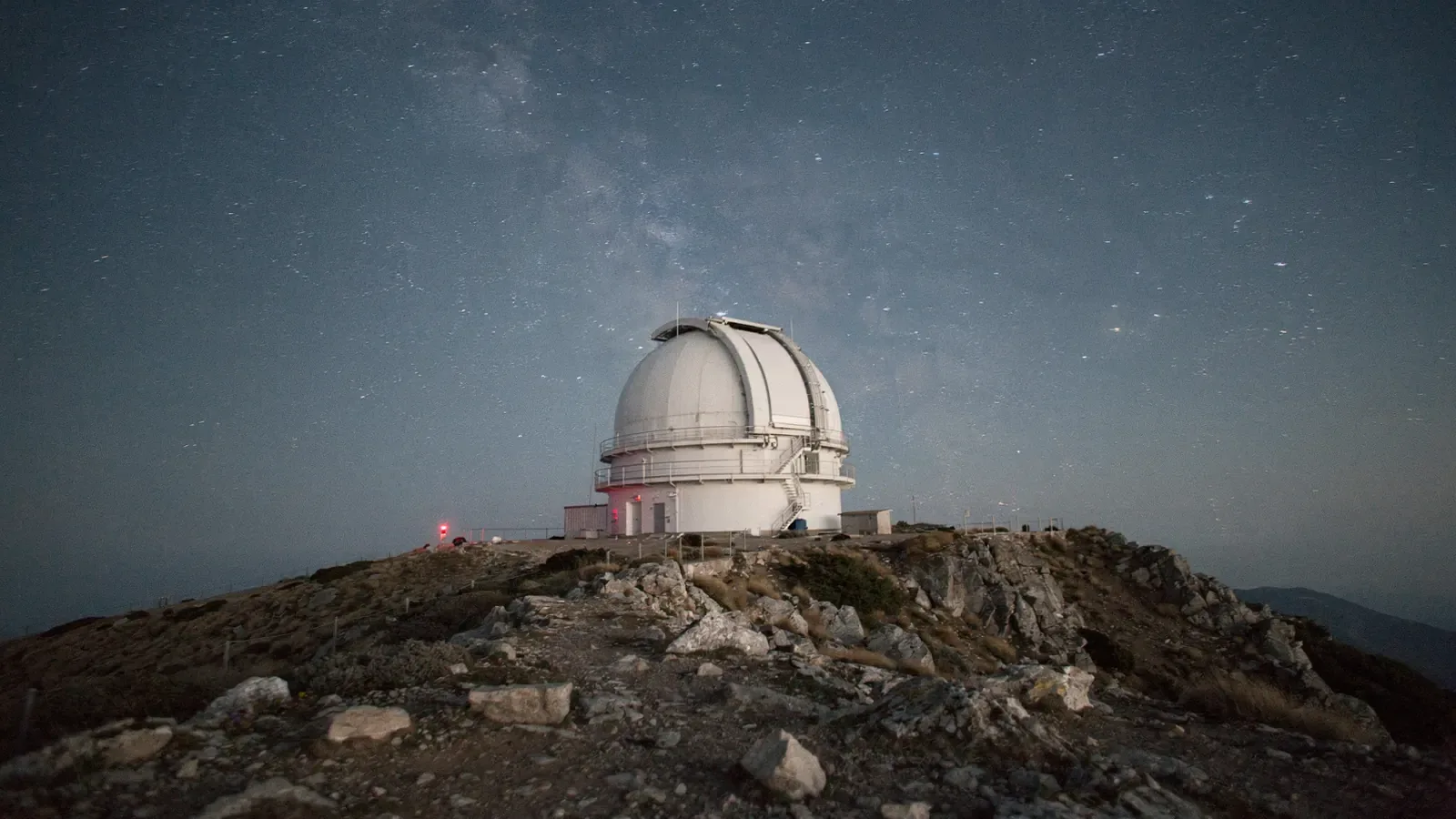
The Vera C. Rubin Observatory is a telescope on Cerro Pachón in Chile built to film the night sky rather than photograph it once. Its 10-year Legacy Survey of Space and Time (LSST) officially began at the end of June 2026. By repeatedly imaging the entire southern sky, it is designed to catch anything that moves or changes, from nearby asteroids to exploding stars in distant galaxies.
What is the Vera Rubin Observatory?
Rubin is an astronomical observatory jointly funded by the US National Science Foundation and the Department of Energy and operated by NSF NOIRLab and SLAC National Accelerator Laboratory. It combines an 8.4-metre telescope with what its operators call the largest digital camera in the world, a 3,200-megapixel instrument roughly the size of a small car and weighing about 2,800 kg, according to the observatory's first-images release.
The observatory is named after Vera Rubin, the American astronomer whose measurements of how fast galaxies rotate became key evidence for dark matter. Its first images were released on 23 June 2025, after first photons were recorded in April 2025, according to Wikipedia's account of the project history.
When did the Legacy Survey of Space and Time begin?
The survey began at the end of June 2026, and Rubin announced its official start on 30 June. The head of LSST, Željko Ivezić, said the decision followed a period of system optimisation and a careful operational review, according to the observatory's press release. Brian Stone, performing the duties of the National Science Foundation's director, described the launch as the start of filming "the greatest cosmic movie ever made".
How does Rubin observe the sky?
Rubin works by speed and repetition: it takes a new image about every 40 seconds and returns to the same patch of sky again and again. Each exposure covers an area of sky equal to about 45 full Moons. The observatory takes about 1,000 images a night and covers the visible southern sky every three to four nights.
| Measure | Figure |
|---|---|
| Main mirror | 8.4 metres |
| Camera | 3,200 megapixels, about 2,800 kg |
| Images per night | about 1,000 |
| Visits to each point of sky over ten years | about 800 |
| Data per night | about 10 terabytes |
| Alerts per night | up to 7 million |
| Galaxies expected over the survey | about 20 billion |
| Total data over ten years | around 500 petabytes |
Over the decade, every point in the southern sky will be revisited about 800 times. The 2026 release says the final dataset will contain billions of objects with trillions of measurements. Data estimates vary between releases: the 2025 first-images release cited about 20 terabytes a night and around 500 petabytes over ten years, while the 2026 release says the observatory is collecting about ten terabytes a night.
What has Rubin discovered so far?
Rubin's biggest early haul is asteroids. During roughly six weeks of optimisation surveys before the official start, it found more than 11,000 asteroids never seen before, including 33 near-Earth objects and 380 objects beyond Neptune, the observatory reported. Its first ten hours of test observations in 2025 had already turned up 2,104 new asteroids, seven of them near-Earth asteroids.
The survey has four main science goals: studying dark energy and dark matter, mapping small bodies in the Solar System, detecting transient events such as supernovae, and mapping the Milky Way.
- Dark energy and dark matter: using measurements of billions of galaxies.
- The Solar System: finding and tracking asteroids, near-Earth objects and bodies beyond Neptune.
- Transient events: catching objects that suddenly appear, brighten or fade, such as supernovae.
- The Milky Way: mapping the stars of our own galaxy.
Who can use Rubin's data?
Rubin's alerts are open to everyone. The observatory's alerts page states that alerts are "world public and have no proprietary period". They are passed to independent software services called brokers, including ALeRCE, AMPEL, ANTARES, Babamul, Fink, Lasair and Pitt-Google, which filter and classify the stream so that astronomers can pick out the events they want to study.
Handling that volume relies on automated software filtering millions of events a night, a different kind of automation from the assistants described in our explainer on AI agents in everyday software.
Do satellites threaten Rubin's images?
Satellites are a real but manageable problem: bright low-orbit satellites leave streaks across long-exposure images, and Rubin's wide view and sensitivity make it especially exposed. A 2022 study by Rubin scientists simulated about 40,000 satellites from the planned Starlink and OneWeb constellations. It found that giving up 10% of observing time to avoid satellites would halve the share of visits with streaks, a trade-off between data quality and survey time.
Rubin's archive will grow for a decade before scientists can study its full record. For a very different kind of long-term storage, see our explainer on how the brain keeps memories for years.
Frequently asked questions
Where is the Vera Rubin Observatory?
Rubin sits on Cerro Pachón, a mountain in the Chilean Andes at an altitude of about 2,700 metres. The observatory is operated by NSF NOIRLab and SLAC National Accelerator Laboratory, with funding from the US National Science Foundation and Department of Energy.
How long will the Rubin survey last?
The Legacy Survey of Space and Time is planned to last ten years from its official start on 30 June 2026. Over that period, each point in the southern sky will be imaged about 800 times, building what the observatory describes as a time-lapse record of the changing universe.
Can the public see Rubin's images?
Yes, in part. Rubin publishes images and news on its website, and its nightly alerts about changing objects are world public with no proprietary period. Astronomers can access those alerts through broker services such as ALeRCE, ANTARES, Fink and Lasair.
Will Rubin find asteroids that could hit Earth?
Its early results point to very large numbers of new asteroids. In about six weeks of test surveys before the official start it found more than 11,000 new asteroids, including 33 near-Earth objects. Finding and tracking such objects early is the first step in assessing whether any pose a risk.
Why is it called the Legacy Survey of Space and Time?
Because it measures both where objects are and how they change over time. By imaging the same sky repeatedly for a decade, the survey can detect motion and brightness changes, from asteroids crossing the Solar System to supernovae in distant galaxies, and leave a lasting data archive.
Sources
- Rubin Observatory — Action! NSF–DOE Vera C. Rubin Observatory begins capturing the greatest cosmic movie ever made (30 June 2026)
- Rubin Observatory — First imagery from Rubin Observatory (23 June 2025)
- Rubin Observatory — Alerts and brokers (updated 25 October 2026)
- Hu, Rawls, Yoachim and Ivezić — Satellite constellation avoidance with the Rubin Observatory LSST, arXiv (29 November 2022)
- Wikipedia — Vera C. Rubin Observatory (accessed November 2026)
More to read

How memories last: what neuroscience knows about long-term memory
Long-term memories last because the brain strengthens connections between neurons, then reorganises and reinforces them over days to years, much of it during sleep. Recent mouse studies have identified molecules and gene programmes that keep memories stable.
Lithium battery recycling: how it works and why so little is recovered
Lithium-ion batteries can be recycled by smelting, chemical leaching or newer direct methods, recovering metals such as lithium, cobalt and nickel. About a fifth of battery lithium is now recycled, and the EU requires 50% recovery by the end of 2027.
First year above 1.5C: 2024 crossed the line, and 2026 is set to follow
2024 was the first calendar year more than 1.5C warmer than pre-industrial times. Copernicus says 2026 is virtually certain to be the second, but the Paris Agreement limit refers to a 20-year average, not single years.